

Equity grants of 0.25% — 1.0% are the standard rate for compensating startup advisors
As a mentor at a number of accelerators, I’m sometimes asked to continue the relationship as an advisor to the company.
Invariably, the first question the founders need advice on is how to compensate me for my role.
Most of the questions founders ask don’t have simple answers. Fortunately, this one does. But before we get to that, let’s make an important distinction.
Working vs Advising
If you want me to create a pitch deck, find investors, sign up customers, or build a marketing campaign, well…that’s real work. That’s a job and I expect to be compensated as a consultant or co-founder.
If instead you want to pick my brain or take advantage of my contacts, that’s different. That’s easy. Whether it’s a scheduled hour each week or an occasional phone call, it’s not a big commitment. But advisors do expect to receive a small amount of equity in compensation for our efforts. The question is how much?
Advisor Shares
How much am I worth? An hour of my time could save 100 of yours. Or lead you from a dead-end path onto the route to success. An hour of my time might save 10 hours you’d spend on lawyers. Based on that, I estimate my value at $8,600 per hour. Will anyone pay that rate? So far, I don’t have any takers.
How much should you pay? The standard consensus is that advisors and mentors are granted between 0.25% and 1.0% of the company stock vested over 4 years.
Within that range, the exact amount depends on 4 factors:
- startup stage: 1% of a $100M Series B startup is very different from 1% of a pre-revenue startup. The earlier the stage, the larger the stock grant.
- level of commitment: a board member should be compensated more than someone available for a monthly call or an occasional introduction to investors.
- length of time: someone who helps out for years should receive more than someone whose role is limited to a few months. Most advisors fill gaps at one particular stage so it’s rare to remain an active advisor for more than a year or two. A 1.0% grant over 4 years should really be considered a grant of 0.25% per year.
- value add: an advisor who brings in million dollar investments or introduces big customers is more valuable than an advisor who provides tips on improving the pitch deck.
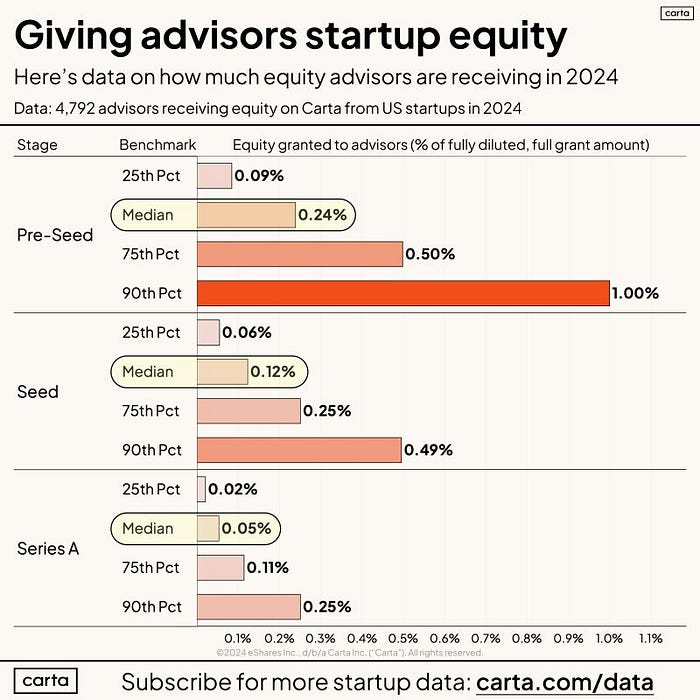
This data recently provided by Peter Walker of Carta gives the typical ranges for advisor equity based on actual grants made to nearly 5,000 advisors.
At pre-seed, the median is 0.24%. At seed — 0.12%. For companies that reach Series A, the grants average only 0.05%.
Another way to determine a fair equity grant is based on the Founder’s Institute FAST (Founder / Advisor Standard Template) Agreement that I highly recommend.
This template divides advisors into 3 performance levels based on time commitment. It recommends the following grants based on a 2 year vesting period:
- Standard: 5 hours per month. Recommends 0.25% for idea stage, 0.20% for startup stage, and 0.15% for growth stage startups.
- Strategic: 10 hours per month. Recommends 0.50% for idea stage, 0.40% for startup stage, and 0.30% for growth stage startups.
- Expert: 20 hours per month. Recommends 1.0% for idea stage, 0.80% for startup stage, and 0.60% for growth stage startups.
The template defines idea stage as part-time founders in customer discovery, startup stage as full-time founders at MVP, and growth stage as in-revenue startups.
The FAST template is a great resource that makes it easy to offer equity to advisors without having to create your own legal documents.
Advisors should receive common shares, the same class of shares as founders and employees. Investors who put cash into the company receive preferred shares that provide protections that aren’t applicable to advisors.
Tax Implications of Advisor Shares
Be aware that if you give advisors stock in the company, the taxman considers it income, no different than if you paid the equivalent amount in cash.
But how much is the equivalent amount in cash? It’s hard to know. The stock has to be valued at its fair market rate, however that can be determined.
If the company has recently raised a funding round at a valuation of $20M, then 1% of the company’s shares is worth $200K. That means I’ll have to pay around $100K in taxes just to become your advisor and receive shares that are unlikely to ever be worth anything. [However, common shares may be worth substantially less than the preferred shares sold to investors.]
If you haven’t raised capital yet and haven’t paid for a 409a valuation study, then you have to talk to your accountant and lawyer to determine what valuation to use. Don’t use the par value as that is not the fair market value and is likely to raise red flags at the IRS.
If the advisor expects to vest options over multiple years, they need to file a 83(b) election within 30 days of receiving the stock grant to pay taxes immediately on the current value rather than the (hopefully much much higher) value in 1–4 years when the rest stock vests and becomes taxable income.
Stock options are better than actual shares because they should have no value at the time they’re issued. But they require having an options plan in place which many startups don’t. Advisors are not eligible for the special treatment of employee incentive stock options.
Don’t Break the Law
It’s tempting to offer advisors shares as compensation for finding investors. Unfortunately, in the U.S., unless the advisor is a licensed stockbroker, any compensation for fundraising is illegal. (If this is news to you, please read this earlier post.)
Anything that looks like a commission or success fee for sales of company stock (including SAFEs and convertible notes) is prohibited, including payments of equity. So be careful about the role advisors play in finding investors and how they’re compensated.
Advisors can be incredibly helpful to startup founders. Their deep experience and industry networks can help startups get off the ground. A good advisor can be a force multiplier, saving founders time and avoiding major mistakes.
Advisors can be found through personal networks and accelerators, or start as customers or investors. Every founder should have at least 3 or 4 advisors whose judgement they trust to help with problems and decisions.
Plan to compensate your advisors 0.25% to 1.0% of equity based on their commitment and responsibilities. And take advantage of the FAST Agreement to make it easy to set up advisor compensation within minutes.
Satoshi Nakamoto, the king of crypto, is an advisor to the startup, SüprDüpr. But is Satoshi’s insistence that the needs of investors outweigh the needs of customers the right advice for a unicorn developing teleportation? Find out in my novel, To Kill a Unicorn, the most fun you’ll ever have reading about Silicon Valley.
 Pitching Angels