
What to do when VCs demand a clean cap table but angels want to make small investments
Tax day is long past, the end of year is nearly here, and the K-1 tax forms from two of my SPVs are nowhere in sight. My tax accountant calls me nearly every day to remind me the IRS is waiting for my filings. I call the startup founders and demand the tax documents they were supposed to send me last March. They just shrug and say, “We’re working on it.”
Tax complications are just one reason that as an angel investor, I hate SPVs and avoid using them whenever possible. But SPVs can make life easier for founders, and they can be the only way to achieve the clean cap table that later-stage VCs demand. So deciding when to require investors to use an SPV and when not can be a challenge for founders receiving conflicting advice.
In this article, I’ll sort out the pros and cons of SPVs for different investors and offer my rule of thumb for when to use an SPV.
But first, what are they?
What Is an SPV?
The Special Purpose Vehicle is a way of aggregating multiple small investments into a single large investment.
Imagine you have 200 investors who each want to invest $5,000 in your startup. Congratulations! You’ve just filled your $1M pre-seed round.
Now the work begins. Each investor will need to sign your investment documents. Each will need to be tracked on your cap table forever. If the investment is a SAFE or convertible note, there will be a boatload of paperwork to process when the conversion takes place.
But that won’t be the only time you’ll rue all the names on the cap table. Whenever you need to make an amendment to your certificate of incorporation for each new funding round, you’ll need to cat herd those 200 investors to beg them to sign the documents in a timely manner. Half will be unreachable on vacation, the other half too busy to check their in-box. Mail will die in spam filters. Others will bounce. Some investors will might even be dead. Getting a boilerplate document signed will become your full-time job. But that’s not the worst of it.
Each investor will feel the right to call the CEO and everyone on the board and demand to know what the hell is going on with their investment. They may ask for permission to sell their stock or require your help moving it into a trust. If they die, you’ll have to deal with the inheritance of non-transferable stock. And each one will have the legal right to sue the company if they feel you weren’t entirely forthright with them at the time of investment or think the board isn’t fulfilling their fiduciary responsibilities now.
Big companies have thousands of investors. That’s the nature of public stock. But they spend millions on investor relations, millions that startups don’t have. They spend even more fighting off shareholder lawsuits. A hassle you don’t need.
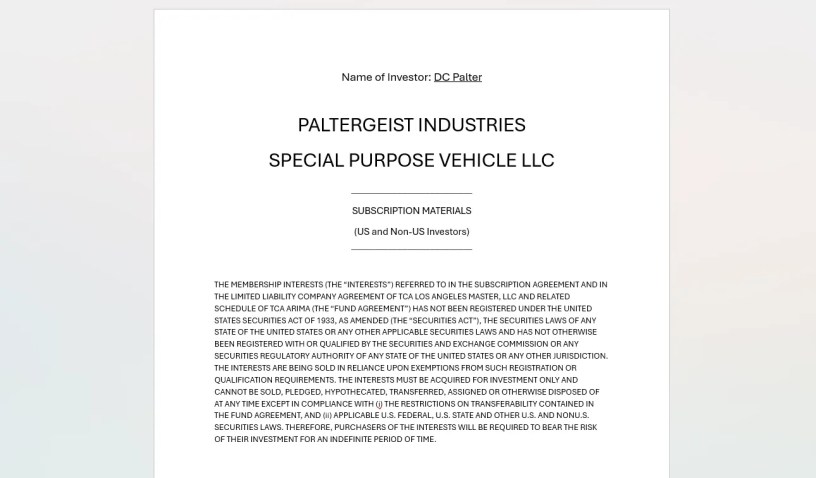
The solution is simple. Instead of accepting checks from 200 individual investors, you ask them to pool the money and write a single check for $1M. They then jointly own $1M worth of the company stock. This is the SPV.
Legally, the SPV is a simple LLC. It’s a flow-through entity that holds a single asset — the stock of your start-up. Ownership of the LLC is proportional to each person’s investment. Once the company exit and the SPV’s stock is cashed out, that cash is distributed to the owners of the SPV, and the is SPV shut down. Easy-peasy, right?
The Upside of SPVs
Now that all the investors have created an SPV together and made a single investment, your life as a founder is easier.
You have only 1 entity on your cap table. One entity that needs to approve and sign any changes. One entity with the legal right to sue the company.
More importantly, large cap tables filled with dozens of investors are a problem for corporate venture groups (CVCs). My friend at the CVC of a large energy company reports that they have to investigate every name on the cap table before they can invest in a startup. Imagine the bad PR if it turned out they had invested in a startup that included as investors Jeffrey Epstein or the former EPA chief disliked by the next administration. Are any from China, Russia, or Iran with even tenuous connections to those governments? A lot of names on the cap table, even if they represent only small investments, means a lot of work to avoid possible PR landmines. If Jeffrey Epstein happened to be one investor in an SPV that invested in the company, the optics are completely different. So the CVC would much prefer a simple cap table with only a few large, well-known investors. And by “prefer”, I mean more likely to invest.
Similarly, big VCs always caution founders against “messy cap tables.” VCs, who look down on angel investors as amateurs who get in the way more than they help, advise founders to use SPVs to aggregate investments from all but the largest angel investments. Since they’ll be on the startup’s board, they want to make corporate governance simple and keep clueless angels out of their hair.
So the SPV sounds great. They make things easier for both founders and big investors. Why wouldn’t you use an SPV? The simple answer — because forcing angels to use an SPV means you won’t get investment from angels like me.
Why Angels Hate SPVs
The SPV is a legal entity that needs to be set up and administered. It needs to account for its expenses and issue a K-1 to every shareholder every year that sees any activity. To cover the costs over a startup’s 10 year expected lifetime, the SPV administrator charges around $20K in fees which have to be paid upfront. For a million dollar investment, those fees are not a big deal. For a $100K investment, they’re a deal killer.
If the company continues on past 10 years, the SPV administrator can charge whatever it wants for future years. A scary proposition. They also take additional fees and sometimes a percentage of the return when the funds are distributed to investors on exit.
Will the fund administrator stick around for the full 10 years of their obligation? Ours didn’t. We had to find another to take over, and paid the full fees twice.
More importantly, the SPV creates governance nightmares for investors. A struggling startup I invested in via an SPV just sent a pay-to-play demand to all investors on its cap table. Any investor who doesn’t reinvest in this round will have their holdings wiped out. The SPV we’d invested through was required to double its investment.
About half the members of the SPV were in favor of re-investing, the other half were against throwing good money after bad. But we had to invest as a single entity rather than as individuals, making it impossible to move forward. We lost our investment.
Another startup has a happier situation — they’re doing a partial acquisition whereby early investors can sell some of their shares. How much should our SPV sell? The answer was different for each individual based on their investment, risk profile, and tax status. But we could only decide as a group, which meant sticking with the default of not selling any shares even though some investors wanted the early return.
But the biggest mess is the SPV that was set up incorrectly and only discovered a year later. Due to a paperwork error by the SPV administrator, I was required to file amended personal tax returns and pay penalties and interest, plus thousands of dollars in accounting fees from my tax preparer. This is not what I want when I make a small investment in your startup.
So my rule is simple — I don’t invest in SPVs except under special circumstances. I’ll consider making an exception for a startup that I invested in at an early stage that’s now doing a $10M Series A round with a $250K minimum. I’m not prepared to invest $250K myself, but I might join with others and invest another $25K via a SPV. But if you’re raising $1M in a pre-seed round and you won’t take my $25K check, then we’re not a good fit for each other.
When to Use an SPV and When Not?
If you’re raising a crowd-funded round with thousands of small investors, you don’t really have a choice — you’ll need an SPV. Fortunately, the crowdfunding services set that up for you (and charge you for the service), so all you’ll see is a single investment from the platform.
For a more typical venture raise starting with friends and family, proceeding to pre-seed/seed with angels and micro-VCs, to Series A with small VCs, and continuing with Series C and beyond with the venture giants, you’ll have to plan ahead.
If you force angels to use an SPV or set a high minimum investment, you may not get the investment you need to get started. But too many lines on the cap table will be a red flag for late investors, especially big CVCs. So it all depends on how much you’ll need to raise and who you expect to raise it from.
The simple solution is to force all investors except the largest to use an SPV. Simple but ineffective. Because that will be a non-starter for a lot of investors like me. As soon as I get a pitch that asks me to invest via an SPV, I hit the reject button.
A good rule of thumb, at least from an angel’s vantage point, is that in the pre-seed/seed stage, set a minimum investment size of $25K. If people want to write smaller checks, they’ll need an SPV, but at $25K and beyond, they’re investing directly with the company.
In a typical $1M raise, there will be an investment of $500K from the lead investor, $100K-$200K from a couple of large angels or angel groups, and perhaps 10 individual angels writing $25K checks each.
That adds 13 entries to the cap table. The big VCs would prefer you limit the cap table to the lead investor and the SPV, or at most the lead plus the two larger checks, aggregating the $25K investments into an SPV. That may be their preference, but I’ve never heard of a late-stage deal killed by a cap table with 13 pre-seed investors instead of 3.
On the other hand, I have seen many, many pre-seed/seed deals killed by founders who got bad advice from VCs and set the minimum check size to $100K to force angels to invest via an SPV. They were rejected by angel investors, making the fact that Series C investors demand a clean cap table entirely moot.
When you reach Series A where you’re raising $10M from larger investors, that’s the time to set the minimum check to $100K, though with a lower threshold for existing investors since they’re already on the cap table.
Summary
SPVs are a great tool to aggregate large numbers of small investments. But they add significant cost and create tax, legal, and administrative complications that make them hated by angel investors.
Be sure to balance the advantages of a simpler cap table with the potential loss of angel investment if you make an SPV a requirement.
With a $500M raise, the teleportation startup, SüprDüpr, isn’t taking small checks from investors. Want to invest $10M in the hottest startup in Silicon Valley? The only option is to aggregate enough investors into an SPV to reach their $50M minimum.
But maybe that isn’t such a good idea. Because an SPV investment won’t get you inside access. It won’t help you figure out if the company is legit or the latest startup scam. It won’t get you board observer rights or even the chance to sit down with Satoshi Nakamoto, the king of crypto and the startup’s board chairman. And it won’t help you figure out why the Chief Elephant Officer is missing on the eve of the company’s big demo.
So what should you do? Hire Ted Tatsu Hara, hacker extraordinaire, to find out what’s really going on inside the mysterious startup.
Read more in my farcical, award-winning Silicon Valley mystery novel, To Kill a Unicorn.
 Pitching Angels