
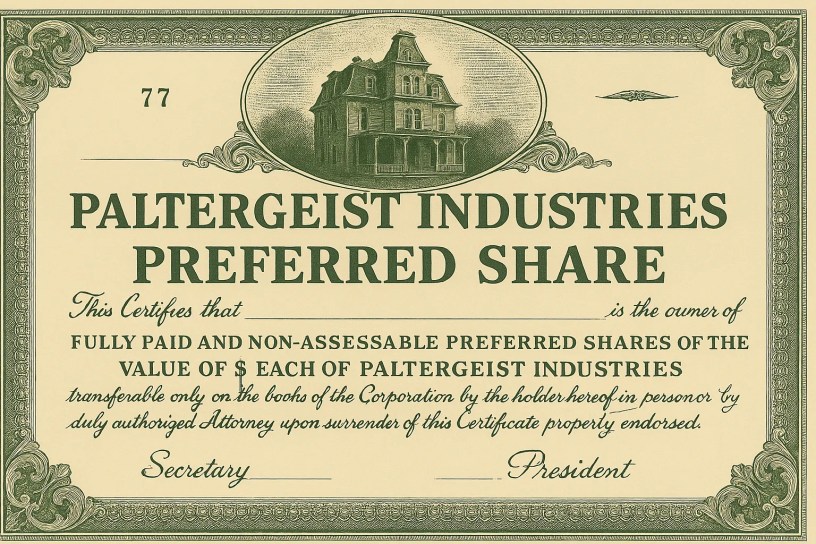
Understanding share classes and why they matter to you
In the world of public stocks, founders, employees, and investors all hold “common shares” in the company. But investors demand preferred shares. Why?
Imagine a startup founder who sells 10% of her company at a $20M valuation, depositing those checks totaling $2M into the company’s bank account. The very next day, she sells the business for $2M.
It’s a neat trick. And perfectly legal. The buyer pays $2M and gets the $2M in cash in the bank, so it costs them nothing. The founder owns 90%, so she pockets $1.8M, not a bad payday. The investors get a return of $200K on their $2M investment. They’re not happy.
(This is an extreme example, but you get the idea. If she’d sold the business a year later at $10M, it would be a very common transaction. There’s other variations, too, like paying herself a $2M bonus or issuing a dividend of $2M that we’ll get to below.)
So before making an investment, investors demand 2 things:
- veto rights on sale of the business or other non-operating uses of their cash
- a minimum of their money back in a sale
The way to accomplish these 2 goals is through a separate class of stock called “preferred shares.”
(These preferred shares are not the same as the preferred shares of public companies. The preferred shares of public companies are a combination of equity and loan where investors are guaranteed a dividend but have no voting rights.)
Before the company can be sold (or other ways of emptying the bank account), the sale must be approved by a majority of preferred shareholders.
And if the company is sold, investors have the option of getting their investment returned before common shareholders get anything. This is called a “liquidation preference.”
Sound simple? It is. But then a lot more stuff gets layered on top.
Multiple Classes of Preferred Shares
Our founder sells 10% at a $20M valuation today. Then two years later, she sells another 10% of the company to bigger investors at a $50M valuation.
Those investors don’t want the same preferred shares as the earlier investors since they would only own half of the shares. Since our interests and theirs are not completely aligned, they demand their own veto rights to protect themselves. And since they invested at a higher valuation, which is supposed to mean lower risk, they require their investment back before the earlier group of investors.
The first group of investors is called Series A. The next group gets a new class of preferred shares — Series B. Each time there’s a new round of investment, those investors get their own veto rights and their own liquidation preference.
Bigger Liquidation Preferences
As investment amounts and valuations go up, the risk is supposed to go down, as will returns. So before they investment $250M, late-stage investors may demand not only their money back but a minimum 2x return. Each class of shares not only gets its own liquidation preference, but they may have different multiples.
Last money in is first money out until you get to the pro-rata payout of common shares. This creates a waterfall of which share classes get paid in an acquisition and whether there is any money left for common shareholders.
Investor Conflict
If you think early investors aren’t happy about a later investor getting a 4x return before we get anything, you’d be right. We not only have guard against non-alignment with founders, but with later investors, too.
To protect ourselves, we require not only veto rights on the sale of the business, but veto rights on new investments and new classes of shares.
Each class of preferred shares therefore usually requires approval of:
- sale of the business, closing the business, merging the business, acquisition of other businesses, etc.
- amendments to the articles of incorporation
- changes to the options pool
- changes to the size of the board of directors
- dividends or share repurchases
- licensing the technology to another company or changing the line of business.
In addition, each class of preferred shares usually receives:
- one or more board director or board observer seats
- information rights so we are guaranteed financial and business updates
- pro-rata rights to invest in the next round
All of these terms are really just a way to make sure investors in each round can protect themselves from founders who hold a majority of shares and later investors who will be looking out for their own interests.
Intermediate Rounds
Imagine the company isn’t ready for a big Series B, but needs to raise another $1M from a combination of existing and new investors.
The valuation is different, but the existing investors are open to bringing the new money in as part of the same group instead of creating a new class of stock.
Instead of Series B preferred shares, This extension to the previous round will be Series A2. Since the valuation is different, the documents are different, but the original Series A and the new Series A2 vote together as a single class for anything that needs approval. For voting purposes, they’re treated as a single class of shares but the other terms such as valuation may vary.
Another Subtle Benefit — Income Taxes on Share Grants
There’s another, subtle advantage of giving employees common shares while investors get preferred shares.
When you grant shares or options to employees or advisors, they have to pay income tax on the value. If you’ve just raised a Series A at a $100M valuation, when you give 1% of your shares to a hot new head of sales, the IRS will consider that the same as a paycheck for $1M. Which means your new employee will have to pay around $400K in income tax just to join the company and they’ll lose any income-based benefits and tax incentives. (Options add another level of complexity that I won’t get into here.)
But…it was the preferred shares that were valued at $100M by investors, not the common shares. And by definition, preferred shares are worth more than common shares. But how much more?
If you hire a 3rd party like Carta to do a valuation study that you can show to the IRS, they’re likely to say that applying industry-average EBITDA multiples to your $1M in revenues last year on which you lost $10M, the common shares are only worth $1M. That 1% share grant is valued at $10K on which incomes cases will be $4K or less depending on other income.
Do Founders Ever Get Preferred Shares?
Many founders ask me why they get common shares instead of preferred shares if they’re putting in cash. The simple answer is so that investors can protect themselves from a founder with a majority of shares making decisions that are against their interests. Giving founders preferred shares would defeat the whole point of setting up the separate class of shares.
In most cases, founders will only hold common shares. Those shares will be issued to the founder when the company is established, and possibly, especially for a later founder, as options grants. If the founder puts in personal cash to get the company off the ground, she’ll get common shares. Preferred shares are for investors.
Nevertheless, there is one situation where a founder will end up with preferred shares. That’s when the founder is putting in more money along with other investors into a later round.
Let’s say the Series A round of $1M includes $100K from the founders. In that case, the founders are investors with the same terms as everyone else.
However, if the founders put in $600K of the $1M, then we have a problem. The founders could unilaterally make any changes to the investment terms and remove or ignore the investor protections. In that case, there needs to be separate classes for the founder and other investors, or voting requires a 3/4 vote instead of a simple majority.
Simple, Even if it Looks Complicated. Usually.
When you receive a term sheet with pages of boilerplate text listing all the rights of the preferred shares, it can look overwhelming. But the concept is simple, and most of the boilerplate is simply closing every possible loophole.
However, it’s also easy to bury nasty conditions within that boilerplate with onerous terms that can impair your ability to get a return or raise additional capital later. So make sure to go through all the terms with a lawyer familiar with startups and venture capital.
At the startup, SüprDüpr, the venture capitalists led by crypto king Satoshi Nakamoto got preferred shares while the founder, Dr. Katie Deauville, and chief elephant officer, Ryu Yamashita received common shares. Now that the company is preparing for their IPO, they’ll both be worth billions. Is that connected to Ryu’s sudden disappearance?
Find out in the award-winning Silicon Valley novel, To Kill a Unicorn — the most fun you’ll ever have reading about a startup.
 Pitching Angels