
Raising $1M on a $10M valuation, growing revenues to $100M and exiting for $1B. That’s the plan. The rest are details of how.
As a startup advisor and angel investor, my days are filled with meetings with startup founders looking for venture funding.
They all want money to accelerate their path to market. But most founders have no idea what the venture journey entails.
My articles on critical details like venture math and whether you should take venture funding at all, provide, I hope, some useful context. But even before filling in those details, it’s important to understand the venture game.
By way of explaining what venture capital is (and therefore also what it’s not), I’ve come up with the Startup Playbook.
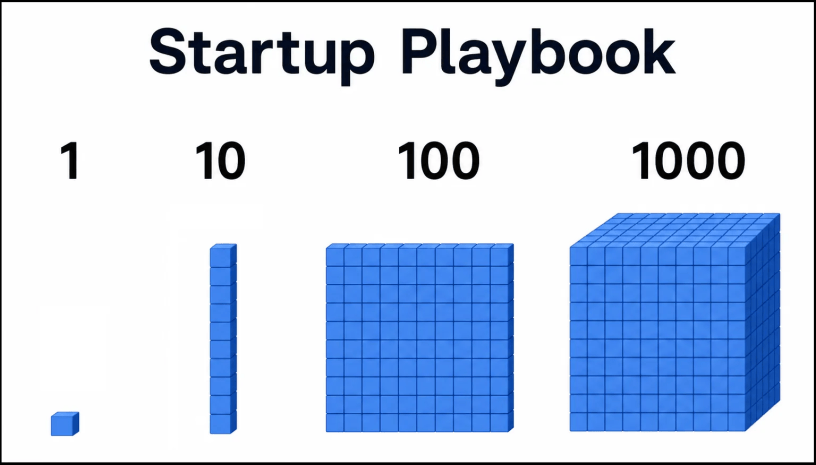
The Startup Playbook is 4 key numbers: 1–10–100–1000.
That’s it. That’s all you need to know. These 4 round numbers are your path from pre-seed to successful exit.
But what do these numbers mean?
- Raising $1M
- At a $10M valuation
- Growing the business to $100M in revenues
- Exiting at $1B
While this sounds simple, there’s a lot of critical information about venture expectations and requirements encoded in those 4 numbers.
Raising $1M at $10M valuation
This is the easy part for founders to understand. Most pre-seed founders are looking to raise $1M to get their venture off the ground. They claim their startup is worth (at least) a $10M valuation.
But think about what this actually means: the company has be worth $10M. Is yours? Why?
That bakery on the corner? It’s generating $1M in revenues every year, $100K in profits to the owners. It’s probably worth around $500K. Why is your startup worth 20x more?
My house, in one of the most expensive neighborhoods in one of the most expensive cities in the world, is worth around $2.5M. Why is your startup with a half-baked product that generates little or no revenue and is years from profitability, worth as much as my house plus those of three of my neighbors?
The answer is because of the next two numbers.
Growing Revenues to $100M (in 5–7 Years)
Investors value the startup at $10M, not because it’s a great idea, not because they love the founders, not even because it’s a great business, but because they expect it to reach $100M in revenues within 5–7 years.
The corollary is that if you can’t convince investors you’ll get to $100M within 7 years, they won’t invest. It’s not that they’ll invest at a lower valuation; they just won’t invest at all. The math doesn’t work otherwise.
Why $100M?
A high-value exit is almost always an acquisition by an industry giant, or in the rare case, an IPO. A sale of the business to private equity or to another startup or SME doesn’t provide the returns investors are looking for.
$100M in revenue is the threshold where Fortune 500 companies consider acquiring a startup at a healthy valuation. That’s the level where the startup is beginning to steal significant market share. It’s the level where the startup stops being a development project and starts being an industry player.
Below $100M, acquisitions still happen to snap up technology or expertise, but not at a price that makes it a successful investment.
Why 5-7 years?
Most VC funds are on a 3/10 timeline. 3 years to invest, 10 years to liquidate the fund. That leaves 7–10 years from the time of investment until the fund needs to be terminated. All investments must exit before then. Since there are always setbacks and delays along the way, investors want to see a plan to reach exit in 5 years.
So think about this. Starting from perhaps $100K in revenues this year, you need to reach $100M in revenues in 5 years.
How big is the market opportunity? How long are sales cycles? How many people will you need to hire? How much will you need to spend on marketing and advertising?
Reaching $100M in revenues in 5–7 years is insanely difficult. Nearly impossible. If you want venture funding, though, you have to convince investors you’re one of the tiny few who can do it. The venture game is to reach $100M or bust. Anything less than that is sub-scale for venture capital; in other words — not investable.
But the important number, the only one that really matters, is the fourth number: 1000
Exit for $1000M
Investors get no return until the exit — when the company is acquired or does an IPO. Only at that point does the company’s stock that the investor purchased years earlier stop being a line on a cap table and turn back into cash, hopefully at a much higher value.
Why $1B? Venture math holds the key.
To make up for 90% of their investments failing, the winners need a 10x return just to break even. To beat the S&P 500 plus multiple rounds of dilution, investors are looking for a 100x return. They might not get it, of course, but that’s what they’re betting on.
Starting at a $10M valuation, a 100x return requires the startup to exit for $1B. So that needs to be the plan.
Pitching Investors
When you pitch investors at the pre-seed stage, you’re asking for $1M at a $10M valuation.
Let’s go back to the first question — why are you worth $10M? The answer now should be obvious — it’s because within 5–7 years, the company will reach revenues of $100M and get acquired for $1B.
And that’s what investors are buying: a lottery ticket on the chance of your startup reaching an exit of $1B.
The higher the probability of you reaching that $1B exit, the higher the valuation.
This should make the logic behind the pitch deck clear. It’s not a collection of random topics that investors want to hear. It’s your blueprint for how you’re going to grow the business to $100M in revenues and exit for $1B.
If you want to raise money from venture investors, it’s not about the founders, not about the product, not about AI. It’s about 1–10–100–1000.
Got a plan to get to $100M in revenues and a $1B exit? Great! You’ll probably need venture capital to get there.
If your technology is new chemistry or materials enabled, we’ll be glad to see you pitch to Chemical Angels. If you’re part of the Los Angeles startup ecosystem, come pitch to TCA Venture Group.
If your startup is smaller and you can bootstrap it, even better! Don’t waste your time with venture capital. If you can bootstrap, you’re so much better off than jumping onto the venture treadmill.
If your startup needs more capital than you can bootstrap but is too niche for venture capital, take a look at operational capital and our UnVenture Capital alternative.

