
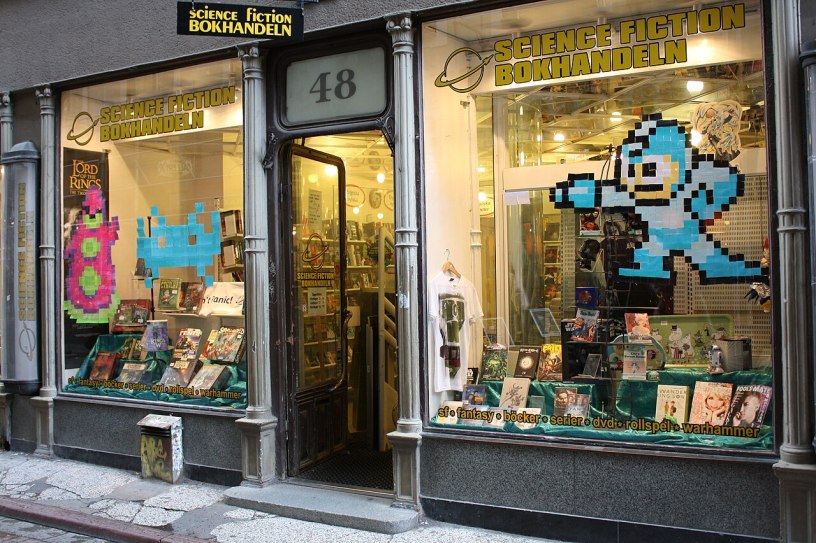
If you aren’t disrupting an entire industry, you need to find a distinct niche
Back in my Apple fanboy days, when I needed a book on Apple programming, 6502 machine language, or VisiCalc hacks, there was only one place to go — the Apple Bookstore on the original Apple campus in Cupertino.
Then one day, I drove to campus only to find the bookstore gone. A sign on the door said all the books were available on Amazon, the new online bookstore (and at the time, only a bookstore). As a bookworm and a tech geek, that was a sad day for me.
At roughly the same time, the movie, You’ve Got Mail, hit the mall screens. Most people watched it for the rom-com chemistry between Tom Hanks and Meg Ryan. I was far more interested in the battle of survival of Meg’s soulful local bookstore against the onslaught of Tom’s goliath bookstore chain. Because in real life, at the time, the threat to bookstores wasn’t Amazon yet, it was the soulless corporate monster, Borders.
Fast forward a decade or two and we know Borders was already a dead man walking. The profits quickly disappeared along with the customers. If all you wanted was a book, Amazon had any book you wanted for 30% less (and no sales tax in those early days). And if you wanted a space to hang out for the day (it was rumored that Borders made more money on coffee than books), Starbucks were popping up on every corner.
Barnes & Noble nearly disappeared, too. Waldenbooks, the in-mall chain went kaput. And so did most of the small, independent bookstores on Main Street that mostly sold the latest Tom Clancy and Danielle Steele best sellers along with newspapers and an assortment of greeting cards and stationary. Meg Ryan had lost it seemed, but so had Tom Hanks, too. A movie sequel, You’ve Got Mail from a Bankruptcy Attorney, was too depressing to get made. All bookstores would be extinct soon, it was predicted. Jeff Bezos ruled the world.
But it turns out, that wasn’t true. Indie bookstores did survive and even come to thrive. But only particular ones. The only ones able to compete with the Amazon juggernaut were the stores that specialized.
The generic bookstores died a slow and painful death. It was sad to watch, but if I wanted a copy of Hitchhiker’s Guide to the Galaxy, it was easier and cheaper to order it right from my computer and have it delivered to my front door than to drive 20 minutes to the mall to pay full retail price.
The ones that survived had something to offer that an online bookstore couldn’t match — community. They specialized in science fiction, bodice rippers, or mystery, they focused on Christian or Buddhist books, or books for children, and every other specialty. They didn’t just sell books — the people working there weren’t clerks — they were guides to what you would like, a human recommendation engine better than ChatGPT. They held events at the store: book clubs, readings, new release celebrations.
Sure, I could buy Project Hail Mary on Amazon, but where else would I meet a room full of geeks discussing alien morphology than a sci-fi bookstore?
At the time You’ve Got Mail was playing at the multiplex, I was heading up the sales and marketing for a startup developing a device to make internet communications faster.
We built a great product that immediately gained market traction. Within days of product release, big companies and military organizations were flying people out to our little office on the second floor above a Circuit City to see the magic for themselves. We couldn’t make our boxes fast enough. A good problem to have. Except…
Cisco got wind of our product. Their customers (basically every big enterprise, government organization, and telecoms company in the world) all wanted it. At the time, Cisco was the most valuable company on the stock market, the Nvidia of 25 years ago.
At first, Cisco offered to resell our product which would’ve been a huge win for us. But before their lawyers had even signed off on the arrangement, Cisco announced a competing product as an optional feature in their routers. Oops.
Cisco was the 800 lb. gorilla of computer networking, and if you were Verizon or IBM or the US Air Force, it was simpler and easier to buy from them than an unknown startup. Even though our product was better, Cisco’s product was integrated into the routers the customers already had running on their network. Competing seemed hopeless. Were we about to be Amazon’ed out of existence?
Cisco’s entry into the market did make it hard to compete in the large enterprise networking space. But within the satellite communications market where network conditions were especially challenging, what mattered was performance rather than brand name. Cisco didn’t have a lock there.
Within that niche, we quickly became the market leader, optimizing the product to meet the unique needs of those customers which were quite different from regular land-based networks. It wasn’t a $100M business, but that’s what actually saved us. The market was too small for Cisco to devote significant resources to making specialized products, but it was big enough to be a very profitable niche for us.
Once my company was acquired, I build a fresh startup to make network simulators. There were already big vendors making network simulators as one component of a suite of test tools. But because their simulators were just an add-on to their other cash cow products, they weren’t very good. For customers already using those other products, the simulator functionality was an easy addition. For everyone else who just needed a network simulator, the competing products were too expensive and complicated to use. That was the opening for us.
We made the best network simulators at the best prices. The market wasn’t huge, but that’s what saved us again. The big guys didn’t bother us and we didn’t bother them, at least for a few years. We took over a market they didn’t really care about and served poorly. It wasn’t hundreds of millions of dollars, but it was a very profitable niche. What the big guys missed is that once we made the best network simulators and gained a solid reputation, we were able to use that as our beachhead to move into the bigger market with new products to take on the giants.
There are 2 distinct strategies a startup can pursue: go big to take over an entire market, or start small in a profitable niche. There is very little in between.
World domination requires money, lots of it. This is the classic venture capital strategy. Grow, grow, grow until you take over an industry (or get bought out for billions to stop you). Don’t worry about profitability until a decade or two later. It’s everything, everywhere, all at once. The odds of success are low, but if it works, you’re a billionaire. If not, you’re bankrupt. Oh well.
The latter is the classic business. Find a niche nobody is serving well and grab it. Make a product or offer a service and sign up customers as quickly as you can. Charge more than it costs to make so you actually generate a profit. Grow the business based on your income. You might clear $100K per year, or maybe $10M. And if you find the right niche and make a useful product, the chances of success are high.
Best of all, instead of being dependent on the whim of investors and whatever is generating FOMO on Sand Hill Road this month, by starting small and generating profits you get to decide whether to invest your profits into growing the business or growing your own bank account.

